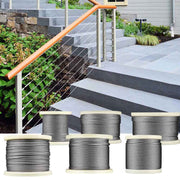
Shop cable railing systems and hardware at The LA Shop, built for DIY deck builders, contractors, and coastal property owners who need stainless steel cable, posts, and tensioning kits for decks and stairs.
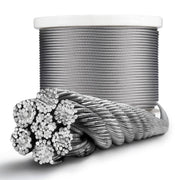
Choose from 1/8" and 3/16" cable, straight or corner posts, tensioning kits, and accessories including protector sleeves, beveled washers, and a wire cutter to build a complete railing.
Explore the full cable railing systems collection today.
FAQ
How do I measure my deck or stairs for a cable railing project?
Measure the total run length, then count how many posts the run requires, including any corners. Match the post spacing to your local building code, since most codes require passing a 4 inch sphere test between cables.
What is the difference between 1/8" and 3/16" cable railing wire?
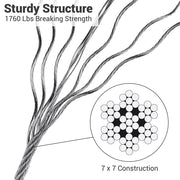
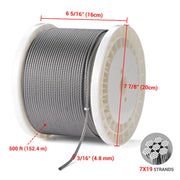
The 1/8" stainless steel cable is rated for 1760 lbs breaking strength and comes in lengths from 150ft to 1000ft. The 3/16" stainless steel cable is thicker, rated for 2284 lbs breaking strength, built for heavier-duty or commercial railing runs.
What length options are available for cable railing wire?
The 1/8" cable comes in 150ft, 300ft, 400ft, 500ft, 600ft, and 1000ft spools. The 3/16" cable is sold in a fixed 500ft length.
What type of post do I need for a straight run of cable railing?
Two post styles suit straight runs. The stair post includes an adjustable top bracket built for stair slopes between 25 and 35 degrees. The level post uses a top bracket sized for flat, level railing sections.
Is there a corner post for cable railing?
Yes. The corner post has 15 pairs of pre-drilled holes across 3 sides, letting one post handle a corner instead of needing two separate posts joined together.
How do I tension cable railing wire?
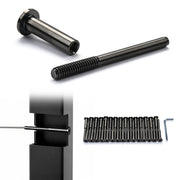
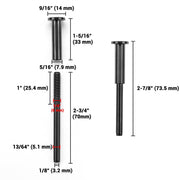
The swage lag screw uses opposing left and right-hand threaded screws to fine-tune tension without sag, working in pairs across a 1/8" cable run. The 60-piece kit includes 30 screws of each thread direction, plus a drill bit and wrench.
Is there a concealed or invisible tensioning option for cable railing?
Yes. The concealed swage tensioner hides the tensioning hardware inside the post for a cleaner look, fitting 1/8" cable on wood or metal posts. The kit includes 30 receivers and a hex key.
What comes in a cable railing tensioning kit?
Two tensioning kits are available, each with everything needed for a single-side railing. The swage lag screw kit includes 30 left-hand and 30 right-hand threaded screws, a drill bit, and a wrench for exposed tensioning on 1/8" cable runs. The concealed swage tensioner kit includes 30 receivers and a hex key for hidden tensioning inside the post.
How do I anchor cable railing to a wall or corner post?
The swage anchor terminal anchors cable to a metal post without visible hardware on the outside, built for wall-mounted posts or spots without side access. Pair it with a separate tensioner on the opposite end of the run.
What hardware do I need for angled stair cable railing?
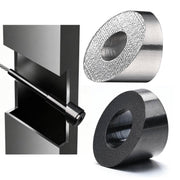
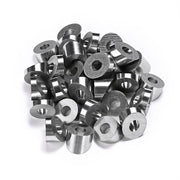
The beveled washer creates a flat bearing surface for hardware mounted on an angled stair post, fitting both 1/8" and 3/16" cable railing kits with a 1/4" threaded stud end.
Do I need beveled washers for a flat deck railing?
No. Beveled washers are only needed for angled stair terminations, where the post hole sits at an angle and requires a flat bearing surface for the hardware to seat correctly. For flat, level deck sections, the hardware mounts square to the post and no washer is needed.
How do I protect the post holes where the cable passes through?
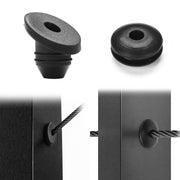
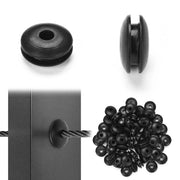
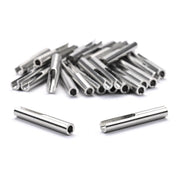
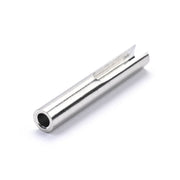
Two sleeve types protect post holes. The rubber protector sleeve fits 1/8", 5/32", and 3/16" cable and guards against corrosion and electrolysis between dissimilar metals. The steel protector sleeve is stainless steel, built mainly for wood posts, and comes with a drill bit for sizing the hole.
What is the difference between the rubber and steel protector sleeves?
Both protect post holes where cable passes through, but they suit different situations. The rubber protector sleeve fits 1/8", 5/32", and 3/16" cable and is built to prevent electrolysis between dissimilar metals, making it the right choice when stainless steel cable runs through a metal post. The steel protector sleeve is T316 stainless steel, built mainly for wood posts to stop the cable from cutting into the wood over time, and includes a drill bit for sizing the hole.
What tool do I need to cut cable railing wire?
The wire cutter cuts stainless steel wire up to 3/16" and cable up to 1/4", built from chrome-vanadium steel and rated for at least 300 clean cuts.
Does cable railing hardware include the posts?
No, they're sold separately. Cable, posts, and tensioning hardware are each their own purchase, so a complete railing run typically needs cable, posts, end or corner hardware, and a tensioner or anchor terminal.
Is cable railing hardware suitable for coastal or marine environments?
Yes. The cable, tensioning hardware, and one of the protector sleeves use T316 marine-grade stainless steel, rated for coastal and saltwater environments. The posts use T304 stainless steel with a protective coating instead.
How long does shipping take for cable railing orders?
Cable railing orders ship free via UPS and typically arrive within 2 to 4 business days across the lower 48 states, though larger orders like cable spools and posts may ship in multiple packages due to size and weight. For full details, see the Shipping Guide.
What is the return policy for cable railing systems?
Cable railing systems can be returned within 30 days of delivery, provided they are unused, undamaged, and in original packaging. For full details, visit the Return Policy.